
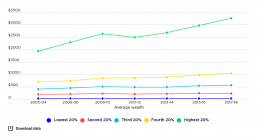
Trends in average wealth by wealth group
This chart shows the real value (after inflation is taken into account) of average wealth holdings of each wealth group, compared over time. [infogram id="_/51MQ2FcUK1NbokAkbwvC" prefix="zTW" format="interactive" title="2017-18: Fig.21_Trends in average wealth by wealth group from 2002-03 to 2015-16 (000s of 2016 dollars)"] As with income inequality, changes in wealth inequality were driven mainly by the highest 20% wealth group, although this growth was more volatile than for middle and low wealth groups. This was due in part to the greater share of the wealth of the highest 20% held in financial assets such as shares. The average household wealth of the highest 20% rose from $1.9 million in 2003-04 to $2.6 million in 2009-10, declined to $2.4 million in 2011-12 and rose again to $3.255 million in 2017-18.

Increase in average wealth by wealth group
[infogram id="_/DXwhDVpKjLxkxdF1UQWL" prefix="ZgV" format="interactive" title="2023_increase in average wealth by wealth group v2"] This graph compares the increase in real value (after inflation is taken into account) of average wealth holdings of each wealth group. Between 2003-04 and 2022-23: The average wealth of the highest 20% wealth group rose by 82%. The average wealth of the middle 20% wealth group rose by 61% The average wealth of the lowest 20% wealth group rose by 20%.
Change in share of overall wealth by wealth group
[infogram id="_/TfznlPfDwnU5SScrrJtO" prefix="jYL" format="interactive" title="2023_change in share of overall wealth by wealth group V2"] This charts hows how the share of all wealth held by different groups changed from 2003 to 2022. The share of the wealthiest 20% grew by 2.7 percentage points, while that of the middle 20% declined by 1 percentage point and that of the lowest 20% fell by 0.3 of a percentage point.

Change in shares of overall wealth by wealth group
This shows changes in the shares of overall household wealth held by each wealth group. [infogram id="_/JNFGRm7KnztFQIFqH9Rm" prefix="7hv" format="interactive" title="2017-18: Fig.23_Change in shares of overall wealth by wealth group, from 2003-04 to 2017-18 (%)"] Between 2003-04 and 2017-18, the highest 20% wealth group increased its share of overall wealth by 4.5%, while the share of all other groups declined. This represents an unambiguous increase in wealth inequality over the period.
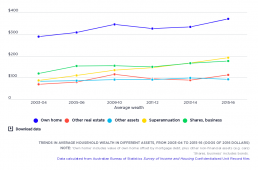
Trends in average household wealth in different assets
[infogram id="_/L9IpRLkDlq24qh6kR1eF" prefix="Acv" format="interactive" title="Fig.6_Trends in average household wealth in different assets, from 2003-04 to 2015-16 (000s of 2016 dollars)"] This shows compares the real value (after inflation is taken into account) of average wealth holdings in different assets. The average value of owner-occupied housing (the largest component of household wealth) rose strongly before the Global Financial Crisis, declined between 2009-10 and 2011-12, and then resumed its strong growth. Overall, the average value of owner-occupied housing rose by 28% (after inflation) during this period. The value of other real estate (investment property) followed a similar pattern. But grew much more strongly overall, by 61%. The average value of superannuation holdings grew very strongly and consistently across the period (by 119% overall), so that its share of wealth holdings increased. From 2003-04 to 2015-16, the share of owner-occupied housing in all household…
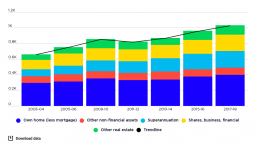
Trends in the concentration of wealth in different assets, from 2003-04 to 2017-18
[infogram id="_/oBP5G0M6HRz3FuVsE88V" prefix="chr" format="interactive" title="2017-18: Fig.19_Trends in wealth inequality (gini coefficient) by asset type from 2003-04 to 2017-18"] From 2003-04 to 2017-18, the overall value of household wealth rose by 56% after inflation, led by strong growth in the value of superannuation, shares and other financial investments, and investment property. In that time, the average value of superannuation held by households (including those who do not have it) rose by 141% from $89,000 to $214,000, shares and other financial assets rose by 74% from $121,000 to $210,000 and investment property rose by 66% from $71,000 to $119,000. The average value of the largest asset - owner-occupied housing - grew at a more modest 35% from $294,000 in 2003 to $398,000 in 2017, along with 8% growth in the value of other non-financial assets from $86,000 to $92,000.
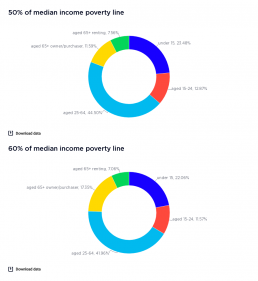
Profile of poverty by age (% of people in poverty)
These graphs show the the number of people living in poverty divided by age groups, by 50% and 60% median income poverty lines, in 2017-18 and 2015-16. 2017-18 [infogram id="_/ATEfU7NryM7szv7BGHdo" prefix="5lM" format="interactive" title="2017-18-Fig.6_Profile of poverty by age (% of people in poverty)"]The largest age group below the poverty line is those of working age (35-64 years), at 45% of all people in poverty (43% using the 60% of median income poverty line). This reflects their high share (53%) of the overall population. 2015-16 [infogram id="_/nAZjADxtYH9F89wRt28j" prefix="uaZ" format="interactive" title="2015-16: Profile of poverty by age (% of people in poverty) 50% median income poverty line"]The largest group below the poverty line was those of working age (25-64 years), at 48.1% of all people in poverty (43.7% using the 60% median income poverty line) reflecting their high share (53%) of the overall population.
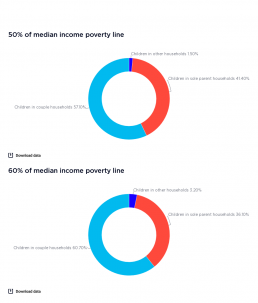
Profile of poverty among children
These graphs display the number of children living in poverty, divided by household type, by 50% and 60% median income poverty lines, for 2017-18 and 2015-16. 2017-18 [infogram id="_/0GvApnjb2OLcOnaoBYEf" prefix="HhL" format="interactive" title="2017-18:Fig 4_Profile of poverty among children up to 15 years (% of children in poverty)"] This graph shows that most children in poverrty live in couple households (57.1% based on the 50% median income poverty line, and 60.7% based on the 60% median income poverty line). This is because the vast majority of children (82%) live in couple households. However, children in sole parent households are over-represented, at 41.4% and 36.1% of all children in poverty. 2015-16 [infogram id="_/UWUSjQyPN7JjNVwxCPQX" prefix="HXX" format="interactive" title="Fig.8_Profile of poverty among children up to 15 years (% of children in poverty)"] This graph displays the number of children living in poverty, divided into their household type. It shows that most…
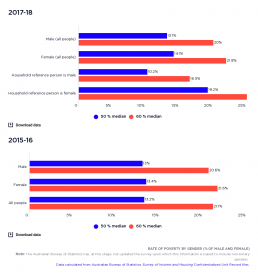
Rate of poverty by gender (% of men and women)
This graph shows the rate of poverty among all people by gender. It shows that people identifying as female are more likely to live in households below the poverty line than those identifying as male, no matter which poverty line is used. Because this website focuses on household incomes, the gap between male and female poverty rates is much less than the gender gap in personal incomes. [infogram id="_/igrKGLKtUyXkvh7lkR1g" prefix="yQ0" format="interactive" title="2017-18: Fig.9_Rate of poverty by gender (% of men and women)"] 2017-18: Women are more likely to live in households below the poverty line than men (14.1% for women and 13.1% for men, using the 50% median income poverty line). The poverty rate for households with a female reference person or main earner is almost twice as high (19.2% using the 50% median income poverty line) as when the main earner is male (10.2% using the 50% median income poverty line). When the 60% of median income pvoerty line is ued, the poverty rates…
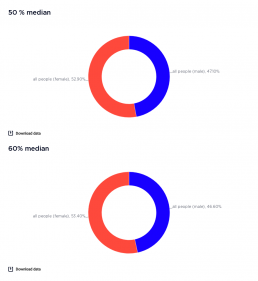
Profile of poverty by gender
These graphs show the number of people living in poverty divided into binary gender groups according to the 50% and 60% median income poverty lines in 2015-16 and 2017-18. Because this website focuses on household incomes, the gap between male and female poverty rates is much less than the gender gap in personal incomes. 2017-18 [infogram id="_/VNvBK2xQQ8jXSWv9Miu8" prefix="Xl0" format="interactive" title="Profile of poverty by gender (% of men and women in poverty), 50% median income poverty line"]This graph shows that a higher share of people in poverty are female – 42.9% compared with 47.1% based on the 50% of median income poverty line, or 53.4% compared with 46.6% using the 60% of median income poverty line. 2015-16 [infogram id="_/YCp67v1XJtNtaVYdu80c" prefix="SLJ" format="interactive" title="Fig.10_Profile of poverty by gender (% of men and women in poverty)"]This graph shows that a higher share of people in poverty were female – 51.5% compared with 48.5% based on the 50% of…