New report tracks economic outcomes for migrants in Australia
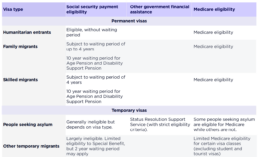
New report tracks economic outcomes for migrants in Australia New research by the ACOSS and UNSW-led Poverty and Inequality Partnership finds that migrants in Australia have comparatively strong employment outcomes and low rates of poverty, but that outcomes vary considerably for people depending on their pathway as a migrant, refugee or person seeking asylum. The report, The first 10 years: Employment, income and poverty among migrants and refugees in Australia, highlights concerningly high rates of poverty among people holding humanitarian, family and student visas, and points to the need for greater employment and financial support to support the wellbeing of new migrants. Unsurprisingly, skilled migrants have the highest employment rates and lowest rates of poverty among the different visa categories. People who are family migrants are more likely to be disadvantaged in the labour market. Women on family visas face particular barriers to employment participation with a…
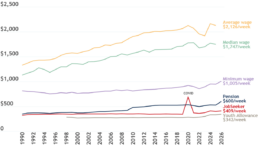
Comparison of income support payments with wages ($2026)
This graph compares the rates of JobSeeker, Youth Allowance and the Pension with average, median and minimum wages since 1990. It shows how JobSeeker (previously Newstart) was at a similar rate to the pension until the different indexation methods meant the payments started to diverge after 2000. Note: Figures have been adjusted for inflation. Sources: ACOSS calculation from Australian Bureau of Statistics (various years), Average weekly earnings, Australia; Services Australia (various years), A guide to Australian government payments; Fair Work Commission (various years), Minimum wage, Australia.
Most think income support is too low to live on
Concerns about poverty in Australia are rising as cost-of-living pressures hit hard, with a majority of people agreeing income support payments are not enough to live on, according to new research by the ACOSS and UNSW Sydney-led Poverty and Inequality Partnership. The vast majority of people surveyed support an increase to JobSeeker, with almost nine in ten (87%) people agreeing that unemployment payments should be enough so people don’t have to skip meals. It comes after the Federal Government’s Economic Inclusion Advisory Committee announced its first recommendation is to increase working-age income support payments in the forthcoming Federal Budget. The new research, which surveyed 2,520 people, found: Three in four (74%) people reject the idea that people on JobSeeker deserve to live in poverty, up from 59% in 2023 Three in four (74%) people agree that poverty is a big problem in Australia, up from 69% in 2023 Less than a quarter (23%) said they could…
Households paying 30% or more of income for housing
This figure shows that households with the lowest income who rented their homes have spent a growing share on their income on rent in recent years, leaving them with less money for other essentials. Among people rent their homes who were in the lowest 20% income group, the proportion who spent 30% or more of their income on rent (ie, in rental stress) rose from 52% in 2020-21 to 57% in 2022-23.
Poverty increases to 1 in 7 people
The number of people living in poverty in Australia has increased to 1 in 7, according to a new ACOSS and UNSW Report released at the start of Anti-Poverty Week. As many as 14.2% of the population - or 3.7 million people - were living below the poverty line in 2022-23, according to the Poverty In Australia 2025: Overview report by the ACOSS and UNSW Sydney-led Poverty and Inequality Partnership, using the latest available data from the HILDA survey. That marked an increase from 12.4% of the population - or 1 in 8 people - in 2020-21. The study found the poverty rate for children is 1 in 6, equalling 757,000 children. “This research shows that 1 in 7 people are now living in poverty. This is unacceptable in one of the wealthiest countries in the world,” said Dr Yuvisthi Naidoo, Senior Research Fellow at UNSW’s Social Policy Research Centre. “The number of people living in poverty decreased in 2020 due to the temporary effective doubling of JobSeeker through the Covid supplement - but…
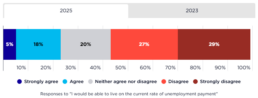
Community attitudes towards "I would be able to live on the current rate of unemployment payment"
This chart shows the responses in our Community attitudes towards poverty and inequality survey to the question whether respondents would be able to live on the current rate of unemployment payment (in the 2025 survey, this was $56 a day). [infogram id="_/W8Rtmo1CMAHtU6JRBFhs" prefix="h9x" format="interactive" title="I would be able to live on the current rate of JobSeeker_202"] 2025: It shows that 56% of people in Australia reported that they could not live on that amount, and 20% were unsure. Only 23% agreed that they could live on the current rate 2023: It shows that 58% of people in Australia said they could not live on that amount and 19% were unsure. Only 23% agreed they could live on the current rate.
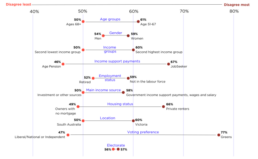
Demographic distribution of community attitudes towards "people would be able to live on the current rate of unemployment payment"
This chart shows the demographic responses in our Community attitudes towards poverty and inequality survey to the question whether respondents would be able to live on the current rate of unemployment payment (in the 2025 survey, this was $56 a day). [infogram id="_/quiECN3Sts7qbbWcWGNe" prefix="FpD" format="interactive" title="Fig32_Would be able to live on current rate of JobSeeker_demographic groups 2026"] By age: People aged 51 to 67 disagreed most (61%) and people aged 68 and above disagreed least (50%). By gender: More women disagreed with this statement (59%) than men (54%). By income: People with the second highest income (Quintile 4) disagreed most (60%) and people with the second lowest income (Quintile 2) disagreed least (50%). By income support payment: People in the lowest income quintile who were receiving JobSeeker payments disagreed most with this statement (67%) and people receiving age pension disagreed least (46%). By employment status: People who were not in the…
Community attitudes towards "unemployment payments should be enough for people to be able to see the doctor when they need"
This chart shows the responses in our Community attitudes towards poverty and inequality survey to the idea that Unemployment payments should be enough for people to be able to see the doctor when they need. [infogram id="_/z5PZu9Wtow7tLXRJQp3h" prefix="pg8" format="interactive" title="Unemployment payments should be enough to see the doctor_2025 and 2023"] In 2025, 85% of people in Australia agreed that unemployment payments should be enough for people to be able to see the doctor when they need. In 2023, 84% of people in Australia agreed that unemployment payments should be enough for people to be able to see the doctor when they need.
Demographic distribution of community attitudes towards "unemployment payments should be enough for people to be able to see the doctor when they need"
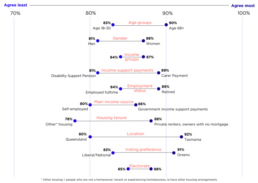
This chart shows the demographic responses in our Community attitudes towards poverty and inequality survey to the idea that Unemployment payments should be enough for people to be able to see the doctor when they need. [infogram id="_/59LqrRsvnhtug2rPz1Ro" prefix="Cbo" format="interactive" title="Fig30_Payments enough to see the doctor_2026 demographic"] By age: People aged 68 and above agreed most (90%) and people aged 18 to 30 agreed least (83%). By gender: More women agreed with this statement (88%) than men (81%). By income: Differences in agreement by income level were small (84–87%). By income support payment: People in the lowest income quintile that were receiving carer payments agreed most (89%) and people receiving disability payments agreed least (81%). By employment status: People who had retired agreed most (89%) and people employed full-time agreed least (84%). By income source: People receiving government income support payments agreed most (86%) and people who were…
Community attitudes towards "unemployment payments should be enough so that people don't have to skip meals"
This chart shows the responses in our Community attitudes towards poverty and inequality survey on whether Unemployment payments should be enough so that people don't have to skip meals. [infogram id="_/FtDJiPc4ZRp95dacuX6G" prefix="GIg" format="interactive" title="Unemployment payments should be enough so no skipping meals_2023 and 2025"] In 2025, 87% of people in Australia agreed that unemployment payments should be enough so that people don't have to skip meals. In 2023, 86% of people in Australia agreed that unemployment payments should be enough so that people don't have to skip meals.