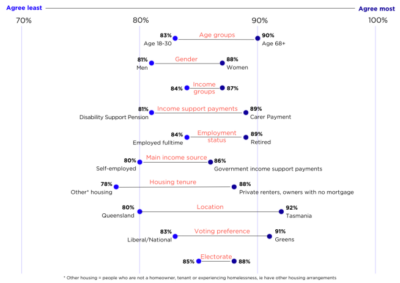
This chart shows the demographic distribution of responses in our Community attitudes towards poverty and inequality survey to the phrase Australia should be a country that looks after those in need.
[infogram id=”_/fHMyi5I4yUoS77d38a3X” prefix=”LSY” format=”interactive” title=”Fig4_Australia should be a country that looks after those in need_2026 demographic”]
- By age: Agreement with this statement differed by age group, ranging from 93% (people aged 68 and over) to 81% (people aged 18 to 30).
- By gender: More women agreed with this statement (89%) than men (83%).
- By income: Agreement was largely consistent across income quintiles (85–88%).
- By income support payment: Those in the lowest income quintile who were receiving carer payments agreed most (96%) compared with those receiving disability payments (85%).
- By employment status: People who had retired agreed most with this statement (93%) and people employed full-time or part-time/casual agreed least (84%).
- By income source: People who were self-employed (92%) agreed most and people receiving wages or salary agreed least (85%).
- By housing status: Homeowners without a mortgage (91%) agreed most and tenants in public or community housing agreed least (84%).
- By location: People from Western Australia agreed most (89%) and people from Tasmania agreed least (79%).
- By voting preference: People who voted for independent politicians agreed most (92%) and people who did not vote agreed least (80%).
- By electorate: Agreement was typically consistent by party affiliation of elected parliamentary representative (86–89%).