
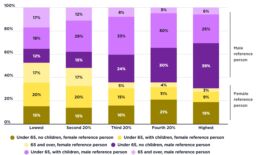
Profile of each income group by gender of household reference person
Families with a female reference person generally have lower incomes than those with a male reference person. The two charts below show the profile of each income group by the gender of the household reference person. 2019-20 This chart shows that a clear majority (70%) of households in the highest 20% income group had a male reference person. [infogram id="_/Alq5YB73P2Whm2EmQe7l" prefix="daw" format="interactive" title="2024_Fig4_Income profile by gender"] 2017-18 This chart shows that the majority (71%) of households in the highest 20% income group had a male reference person. [infogram id="_/VjPVJdwCFm48s4OZSlUi" prefix="U1K" format="interactive" title="2019-20_Fig4_Income profile by gender"]
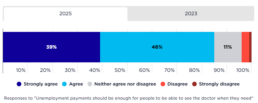
Community attitudes towards "unemployment payments should be enough for people to be able to see the doctor when they need"
This chart shows the responses in our Community attitudes towards poverty and inequality survey to the idea that Unemployment payments should be enough for people to be able to see the doctor when they need. [infogram id="_/z5PZu9Wtow7tLXRJQp3h" prefix="pg8" format="interactive" title="Unemployment payments should be enough to see the doctor_2025 and 2023"] In 2025, 85% of people in Australia agreed that unemployment payments should be enough for people to be able to see the doctor when they need. In 2023, 84% of people in Australia agreed that unemployment payments should be enough for people to be able to see the doctor when they need.
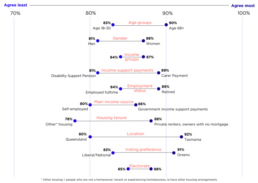
Demographic distribution of community attitudes towards "unemployment payments should be enough for people to be able to see the doctor when they need"
This chart shows the demographic responses in our Community attitudes towards poverty and inequality survey to the idea that Unemployment payments should be enough for people to be able to see the doctor when they need. [infogram id="_/59LqrRsvnhtug2rPz1Ro" prefix="Cbo" format="interactive" title="Fig30_Payments enough to see the doctor_2026 demographic"] By age: People aged 68 and above agreed most (90%) and people aged 18 to 30 agreed least (83%). By gender: More women agreed with this statement (88%) than men (81%). By income: Differences in agreement by income level were small (84–87%). By income support payment: People in the lowest income quintile that were receiving carer payments agreed most (89%) and people receiving disability payments agreed least (81%). By employment status: People who had retired agreed most (89%) and people employed full-time agreed least (84%). By income source: People receiving government income support payments agreed most (86%) and people who were…
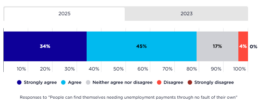
Community attitudes towards 'people can find themselves needing unemployment payments "through no fault of their own"'
This chart shows the responses in our Community attitudes towards poverty and inequality survey to the idea that People can find themselves needing unemployment payments "through no fault of their own" [infogram id="_/z03OHUKQWFh8I1fImk3p" prefix="dD0" format="interactive" title="People can need unemployment payments with no fault_2023 and 2025"] In 2025, 79% of people in Australia agreed that people can find themselves needing unemployment payments "through no fault of their own." In 2023, 78% of people in Australia agreed that people can find themselves needing unemployment payments "through no fault of their own." Note that the wording used for these questions has been chosen as common in public discussion.
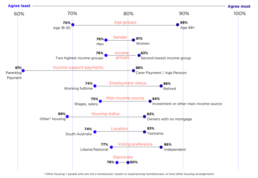
Demographic distribution of community attitudes towards 'people can find themselves needing unemployment payments "through no fault of their own"'
This chart shows the demographic distribution of responses in our Community attitudes towards poverty and inequality survey to the idea that People can find themselves needing unemployment payments "through no fault of their own" [infogram id="_/4VXfIVYluivLVvZ1Oyy3" prefix="HLf" format="interactive" title="Fig22_Needing unemployment payments no fault_demographic groups 2026"] By age: People aged 68 and above agreed most (89%) and people aged 18 to 30 agreed least (70%). By gender: More women agreed with this statement (81%) than men (76%). By income: People in the second lowest income group (Quintile 2) agreed most (82%) and people in the two highest income groups (Quintiles 4 and 5) agreed least (76%). By income support payment: 81% of people in the lowest income quintile who were receiving JobSeeker payments agreed with this statement. People receiving carer or age pension payments agreed most (88%) and people receiving parenting payments agreed least (61%). By employment status:…
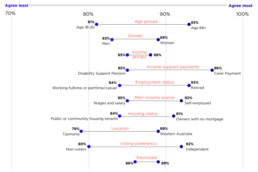
Demographic distribution of community attitudes towards "Australia should be a country that looks after those in need"
This chart shows the demographic distribution of responses in our Community attitudes towards poverty and inequality survey to the phrase Australia should be a country that looks after those in need. [infogram id="_/fHMyi5I4yUoS77d38a3X" prefix="LSY" format="interactive" title="Fig4_Australia should be a country that looks after those in need_2026 demographic"] By age: Agreement with this statement differed by age group, ranging from 93% (people aged 68 and over) to 81% (people aged 18 to 30). By gender: More women agreed with this statement (89%) than men (83%). By income: Agreement was largely consistent across income quintiles (85–88%). By income support payment: Those in the lowest income quintile who were receiving carer payments agreed most (96%) compared with those receiving disability payments (85%). By employment status: People who had retired agreed most with this statement (93%) and people employed full-time or part-time/casual agreed least (84%). By income source: People…
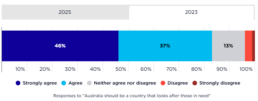
Community attitudes towards "Australia should be a country that looks after those in need"
This chart shows the responses in our Community attitudes towards poverty and inequality survey to the phrase Australia should be a country that looks after those in need. [infogram id="_/JW1jGCaipPn4J2wa7gtn" prefix="8Bf" format="interactive" title="Australia should look after those in need_2023 and 2025"] In both 2023 and 2025, 83% of people in Australia agreed that Australia should be a country that looks after those in need.
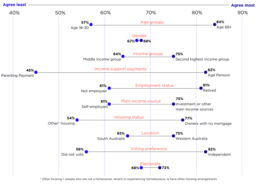
Demographic distribution of community attitudes towards "Incomes at the top are too high"
This chart shows the demographic distribution of responses in our Community attitudes towards poverty and inequality survey to the phrase incomes at the top are too high. By age: Agreement increased markedly by age group, from 57% (aged 18 to 30) to 84% (aged 68 and above). By gender: Agreement was largely consistent between women (67%) and men (68%). By income: Differences varied when compared by income, with people in the second income quintile agreeing most (75%) and people in the third (middle) income quintile agreeing least (64%). By income support payment: People in the lowest income quintile who were receiving the age pension agreed most (82%), compared with those receiving parenting payments (45%), or carer, JobSeeker and disability payments (58–72%). By employment status: People who had retired agreed most (81%) and people who were not employed agreed least (61%). By income source: People who had investment or other main income sources agreed most (75%) and people…
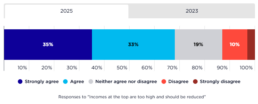
Community attitudes towards "Incomes at the top are too high"
This chart shows the responses in our Community attitudes towards poverty and inequality survey to the phrase incomes at the top are too high. In 2025, 68% of people in Australia agreed that the incomes of those with the most are too high. In 2023, 63% of people in Australia agreed that the incomes of those with the most are too high and should be reduced. Note: Question wording in 2023 survey was incomes at the top are too high and should be reduced and in the 2025 survey was incomes at the top are too high